Disclosure: The article may contain affiliate links from partners who may compensate us. However, the words, opinions, and reviews are our own. Learn how we make money to support our mission.
Financial wellbeing is often described with a swirl of terms—literacy, capability, independence, freedom—and it can feel overwhelming, even for professionals in the field.
But each of these words has meaning. Together, they reflect stages of a person’s relationship with money and their progress toward the ultimate goal: control of their time and choices.
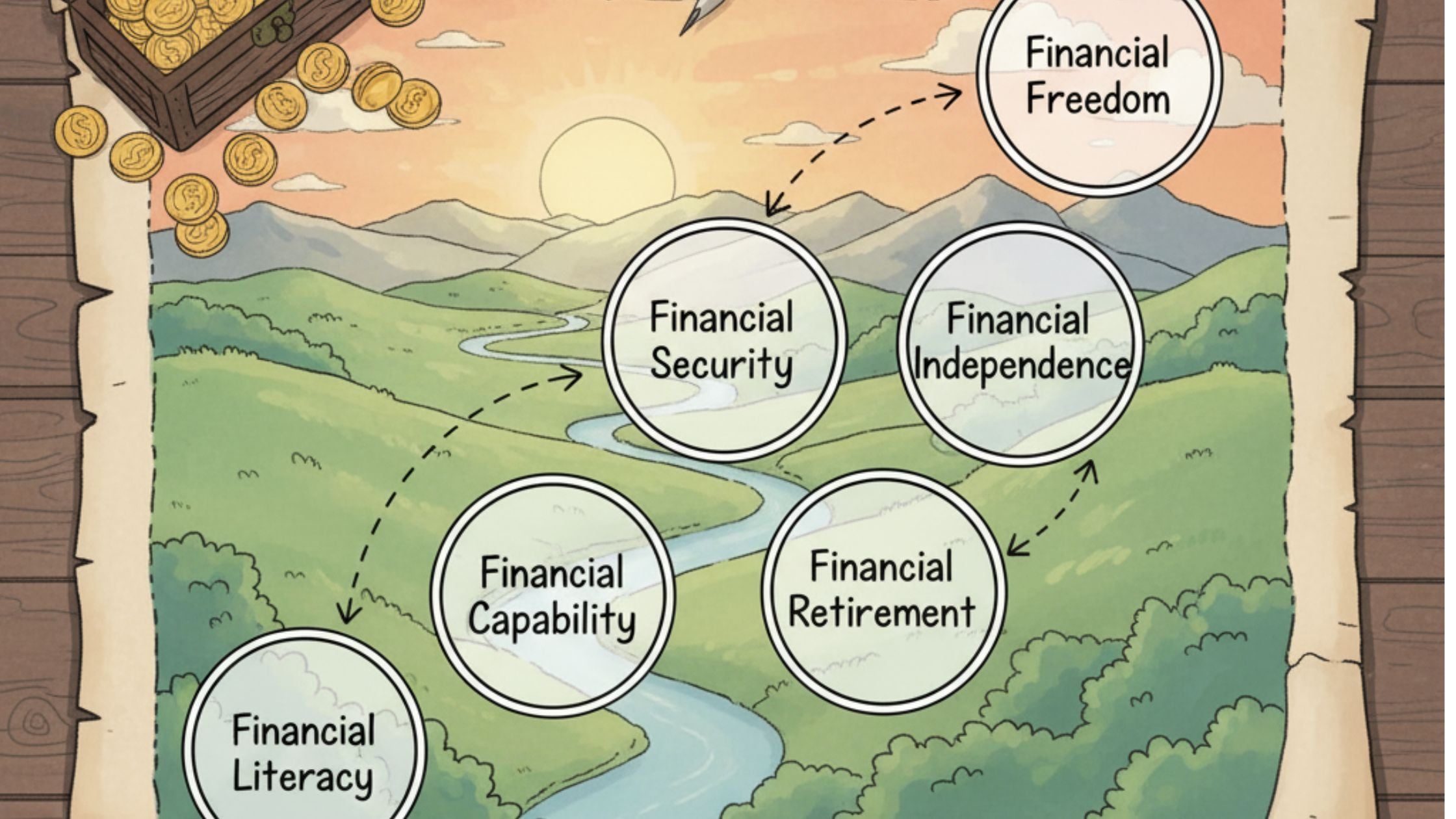
Through my decades of work in financial education and wellness, I’ve come to see these stages not as isolated concepts but as natural progressions. They represent pitstops on the journey toward a life lived with purpose and freedom.
The six stages of financial wellbeing are:
The six stages of financial wellbeing are:
This framework gives us, as educators and coaches, a way to meet people where they are while keeping the bigger vision in sight.
The journey begins with literacy—the basic knowledge needed to understand money—and continues through capability, security, and independence until it culminates in true freedom: the ability to own your time and choose how to live.
When guiding others, encourage them not just to focus on dollars and cents, but to envision how they will use their time once financial freedom becomes reality. That vision becomes the fuel that powers every step forward.
Stage 1: Financial Literacy
Financial literacy is the foundation—understanding the basics of personal finance, banking terms, and how money works.
At this stage, people can recognize products, services, and tools needed to manage daily financial life. Literacy is never “finished”—it’s an ongoing process—but reaching this stage means someone has enough knowledge and awareness to manage money and set meaningful goals.
At stage 1, individuals can answer questions like:
How does compound interest work?
What is a checking account?
What’s the difference between a credit report and a credit score?
Why contribute to a 401(k) plan?
Key features:
Understanding money and banking terms
Budgeting basics
Credit knowledge
Intro to investing and retirement
Stage 2: Financial Capability
Financial capability goes beyond knowing terms—it’s about applying knowledge to make informed, confident decisions. A capable person understands their options, evaluates offers, and effectively manages relationships with banks, lenders, and service providers.
The World Bank defines capability as combining “knowledge (literacy), attitudes, skills, and behaviors…with the ability to access financial services that fit their needs.”
At stage 2, individuals can answer questions like:
Where do you bank and why?
What’s your credit score?
Why do you save money, and how do you spend it?
Key features:
Growth and abundance mindset
Research and verification skills
Assessing financial offers critically
Confident use of financial products and services
Stage 3: Financial Security
Financial security is about peace of mind. At this stage, income covers expenses and debt obligations, and there are savings in place to handle emergencies. An unexpected event doesn’t derail long-term plans.
People here not only meet their basic needs but also enjoy some comforts while steadily building wealth and moving toward bigger goals.
At stage 3, individuals can answer questions like:
What’s your budgeting method?
What’s your net worth?
How much is in your emergency fund?
What’s your debt-to-income ratio and savings rate?
Key features:
Following a budget consistently
Established emergency fund
Healthy debt and credit management
Multiple savings accounts
Investing for the future
Regular retirement contributions
Stage 4: Financial Retirement
Financial retirement is the stage where consistent contributions and planning set someone up for a comfortable retirement. For most, this is a long-term milestone. For others, early retirement becomes possible—opening up time to travel, pursue passions, or give back.
At stage 4, individuals can answer questions like:
How much have you saved for retirement?
Are you on track for a comfortable lifestyle in retirement?
Do you want to work until the traditional age—or earlier?
Key features:
Meeting 401(k) contribution limits
Investing with Roth IRAs and other tax-advantaged accounts
Building multiple income streams
Acquiring income-producing assets
Knowing projected Social Security benefits
Stage 5: Financial Independence
Financial independence is when someone’s assets, savings, and investments cover lifestyle needs—work becomes optional. At this stage, earnings outpace spending, and wealth funds both needs and wants. Independence doesn’t mean lavish wealth; it means choice.
At stage 5, individuals can answer questions like:
Can you explain the 4% rule?
What’s your retirement withdrawal strategy?
How fast are your investments growing?
What would you do with your time if work wasn’t required?
Key features:
Controlling lifestyle inflation
Being debt-free
Robust, diversified savings and investment accounts
Multiple passive income streams
Assets that grow and protect wealth
Stage 6: Financial Freedom
Financial freedom is the ultimate stage: the ability to live fully on your own terms. Like independence, wealth covers lifestyle choices—but freedom adds another layer. Time, not money, becomes the central resource. Work is a passion, not an obligation.
Freedom allows someone to take risks, pursue bold opportunities, or dedicate themselves to purpose-driven work without financial barriers.
At stage 6, individuals can answer questions like:
How do you want to spend your time?
What legacy or impact do you want to create?
Key features:
Complete control over time and choices
Large financial nest egg
Income-producing assets
Strong passive income streams
Well-managed, diversified investments
A Final Thought
For many, the idea of reaching financial independence—or true freedom—feels out of reach. But the progression is possible.
As professionals guiding others, our role is to help people see these stages not as abstract ideals but as a roadmap. Every step—no matter how small—moves them closer to security, independence, and ultimately, freedom.
Jason Vitug is the founder and CEO of phroogal. His writings explore the intersection of money, wellness, and life. Jason is a New York Times reviewed author, speaker, and world traveler, and Plutus-award winning creator. He holds an MBA from Norwich University and a BS in Finance from Rutgers University. View my favorite things→
Jason Vitug is the founder and CEO of phroogal. His writings explore the intersection of money, wellness, and life. Jason is a New York Times reviewed author, speaker, and world traveler, and Plutus-award winning creator. He holds an MBA from Norwich University and a BS in Finance from Rutgers University. View my favorite things→